
Making Space for What Matters
January has a way of surfacing a familiar tug-of-war.
On one side: goals, growth, fresh starts, the quiet hope that this might be the year things feel a little lighter.
On the other: a desire to slow down, be present, and stop treating life like a never-ending self-improvement project.
And if you’re a caregiver, there’s a third voice in the room—practical, relentless, and unimpressed by your intentions:
Caregiving takes time.
A lot of it.
Appointments. Advocacy. Paperwork. Insurance calls. Coordination. Decisions you never asked to make. None of it optional. Very little of it flexible. Much of it arriving in large, immovable chunks.
So the real question isn’t, How do I balance it all?
It’s this:
How do I build a meaningful life around responsibilities that aren’t going anywhere?
I don’t think there’s a neat, once-and-for-all answer to that. And I don’t think it gets solved in one season.
But I have noticed what shifted when my days started to feel more aligned—and less draining.
When I Realized I Wasn’t Actually Taking Care of Myself
For a while, I could tell something was off.
I wasn’t really taking care of myself—not in ways that restored me or helped me grow. I told myself it was because I didn’t have enough time. And honestly? That wasn’t wrong. Caregiving doesn’t leave much margin.
But when I looked more closely, I noticed something else.
Even when time did open up—small pockets or the occasional larger block—I wasn’t using it in ways that actually helped me feel better.
Not because I was lazy or undisciplined.
Because when I was tired and depleted, I drifted toward whatever asked the least of me.
Open time didn’t disappear.
It defaulted.
Scrolling. Background noise. News. Sitting down “just to rest” with no real endpoint. The fastest hit of relief, not the deepest kind.
Not because it’s what I wanted most.
Because it required the least energy.
That’s not a personal failure. It’s what happens when energy is low and attention has nowhere specific to land.
Over time, that drifting creates a quiet disconnect between what matters to us—and how our days actually feel.
The Shift: From “Be More Intentional” to “Be More Clear”
For a long time, I told myself I needed to be more intentional with my time.
But effort wasn’t the issue.
Clarity was.
I hadn’t really thought through how I wanted to use the time that wasn’t already claimed by caregiving. And I hadn’t sorted out which responsibilities truly needed my best—and which just needed to be handled well enough.
Without that clarity, time didn’t restore me. It evaporated.
That’s when I realized I’d been asking the wrong question.
Not:
How do I manage my time better?
But:
What am I actually trying to make space for?
Naming What Restores Me (Before Trying to Protect It)
What helped wasn’t tightening my schedule or becoming more disciplined.
It was naming—sometimes awkwardly, sometimes imperfectly—what actually lights me up instead of drains me.
Until I did that, there was nothing specific to protect.
I started asking quieter, more honest questions:
-
What helps me feel more like myself?
-
What restores me instead of just numbing me?
-
What supports my growth—even in small ways—in this season?
The answers didn’t arrive all at once. But once I started noticing them, something shifted.
Making Space (Not a Perfect Schedule)
Once I had a clearer sense of what I wanted more of—joy, steadiness, learning, creative expression—I could be more deliberate about making room for it.
That’s where simple structures helped.
Not rigid plans.
Realistic pockets.
I began intentionally using time blocks, whether a sliver or a chunk of time, to do the things I’d already decided mattered:
-
Movement
-
Learning
-
Creative work
-
Reflection
-
Meaningful rest
-
Work that actually moves the needle
Not all of these every day.
Not perfectly.
But intentionally.
Those pockets didn’t create meaning.
They protected it.
This wasn’t about optimization or control.
It was about follow-through on what I already knew mattered.
Why Being Effective Still Matters (Especially Here)
There’s another piece that matters, especially for caregivers.
Being reasonably effective and organized isn’t optional. If we’re not, things unravel fast. Appointments get missed. Paperwork piles up. Communication breaks down.
That’s not hustle culture.
That’s survival.
The goal isn’t to do more.
It’s to do what’s necessary well enough so it doesn’t consume everything else.
When caregiving work is supported and manageable, it creates breathing room. And that breathing room is what allows space for restoration, joy, and growth.
Productivity is the tool.
Meaning is the goal.
This Doesn’t Happen Alone
One thing I don’t want to gloss over: none of this happens in isolation.
Creating more space in my life didn’t come from “doing caregiving better” on my own. It came from gradually building support by sharing responsibility, accepting help, coordinating care, and letting go of the idea that everything had to rest on me.
Support (both formal and informal) is essential. It’s what makes it possible to handle caregiving and have something left for the rest of life.
How we built that support system is a bigger story. One I’d love to explore in a future post.
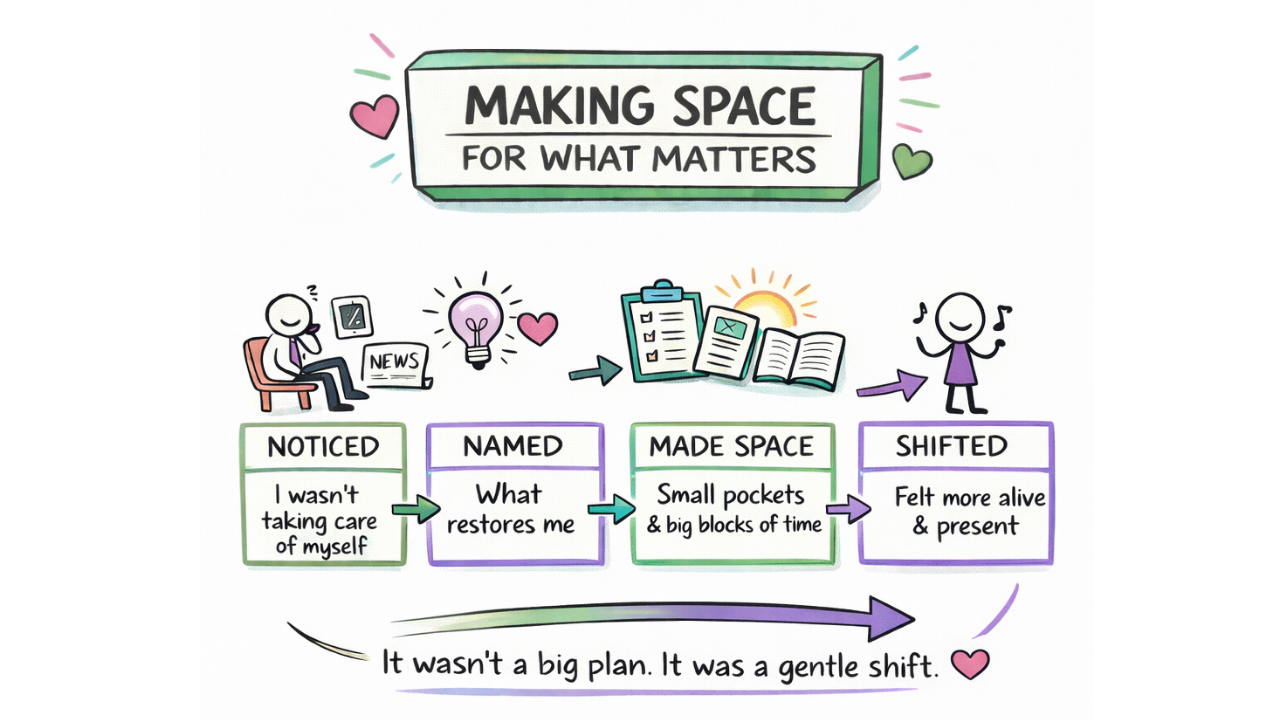
What Actually Shifted
Looking back, the change wasn’t dramatic.
I noticed I wasn’t taking care of myself.
I blamed a lack of time.
I realized some of my time was quietly draining instead of restoring me.
I named what actually helps me feel more alive.
And then I built just enough structure to make space for it.
Not perfectly.
Not consistently.
But deliberately.
One question to ask
If this resonates, here’s a question to start with:
What’s one thing that genuinely lights you up—or steadies you—in this season?
And what tends to crowd it out when you don’t protect it?
You don’t need a full system yet.
Clarity comes first.
The rest can follow.
You’re Not Behind
If your days feel full and your energy feels thin, that’s not a personal shortcoming. It’s often the cost of loving and caring deeply.
Building a meaningful life around caregiving isn’t about finding the perfect schedule.
It’s about staying connected to what matters, even in small, imperfect ways.
This is an ongoing conversation. One I plan to keep exploring.
And honestly?
Asking these questions at all is already meaningful work.
Want a simple way to start?
If the idea of “making space” feels good but also a little abstract, I created a short, practical guide to help.
The Right-Sized Time Guide shows you how to use the time you actually have—tiny pockets, medium breaks, and longer stretches—more intentionally, without adding pressure or complexity.
It’s not about doing more.
It’s about matching the right kind of activity to the time and energy you have.
👉 Download the Right-Sized Time Guide here
